
Sin Tracker: Seven Sins · iOS 17+ · watchOS 11+
A seven deadly sins tracker that roasts you instead of cheering
Sin Tracker is a tongue-in-cheek habit tracker for iPhone and Apple Watch: tap a day, log pride, greed, lust, envy, gluttony, wrath or sloth, and get a sarcastic one-liner back. For anyone tired of motivational quotes.
Habit trackers are a little too cheerful
- Every habit app wants you to drink water and meditate. None of them has a button for "ate the whole pizza out of spite".
- Streaks and confetti feel great until you break one, and then the app just quietly makes you feel worse.
- You suspect you snap at people or doomscroll more than you admit, but without writing it down it is easy to pretend otherwise.
- Self-improvement content takes itself very seriously. Sometimes you want something that laughs at you, and with you.
What Sin Tracker actually does
Seven sins on a calendar
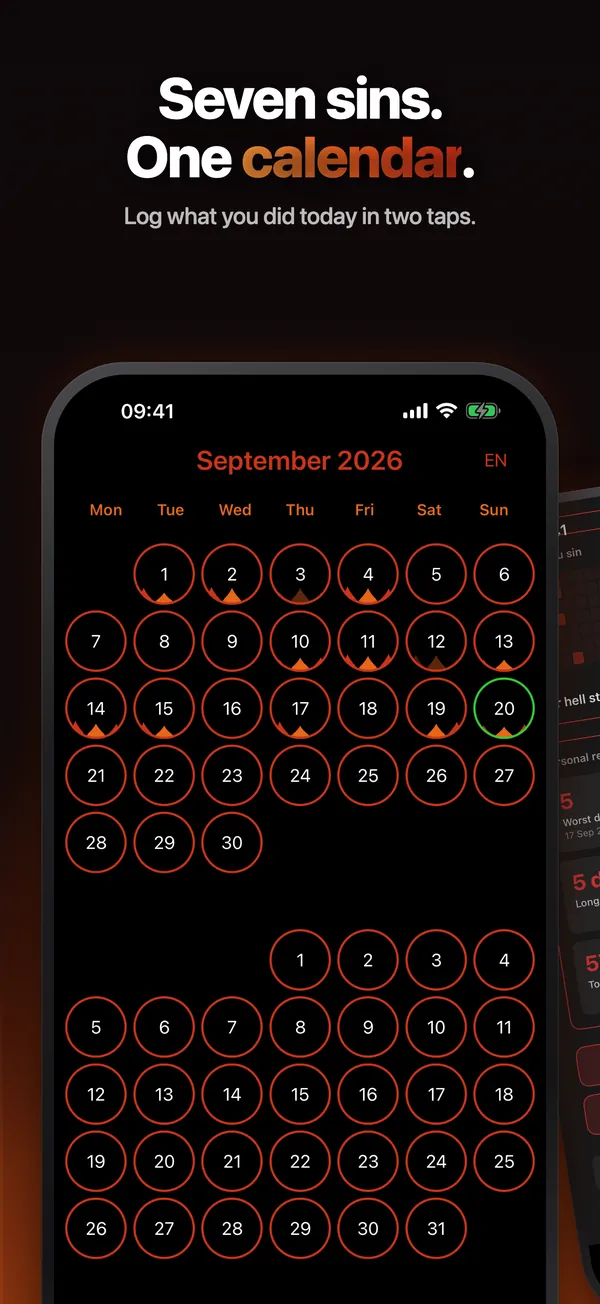
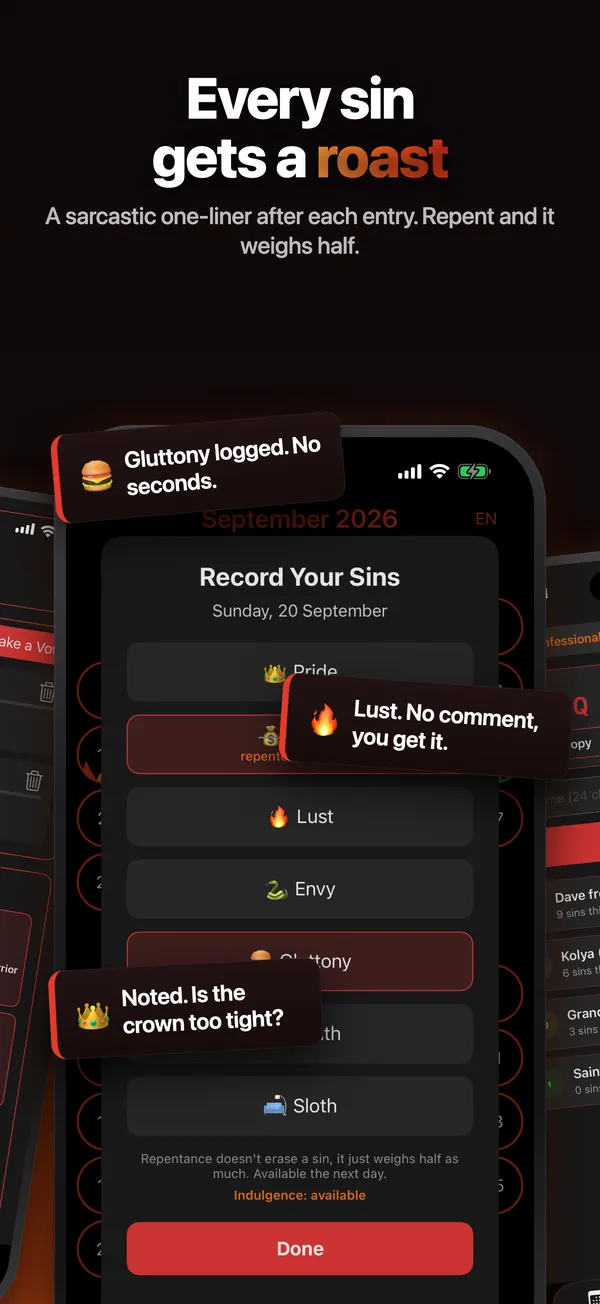
Tap a day and log pride, greed, lust, envy, gluttony, wrath or sloth in two taps. Repent the next day and the sin weighs half as much. Once a month you get an indulgence to spend.
Thirteen sinner levels, nine circles
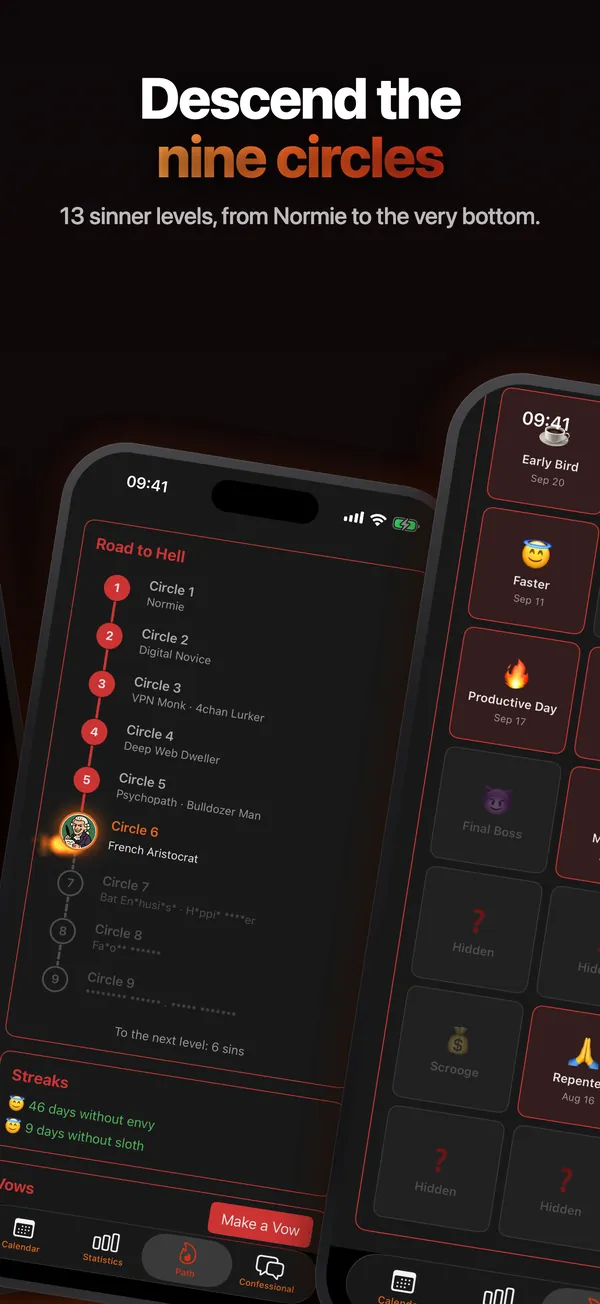
Sin more and you descend, stay clean and you climb back. The road down is drawn out one circle at a time, so you always see where you are heading.
Statistics that judge you
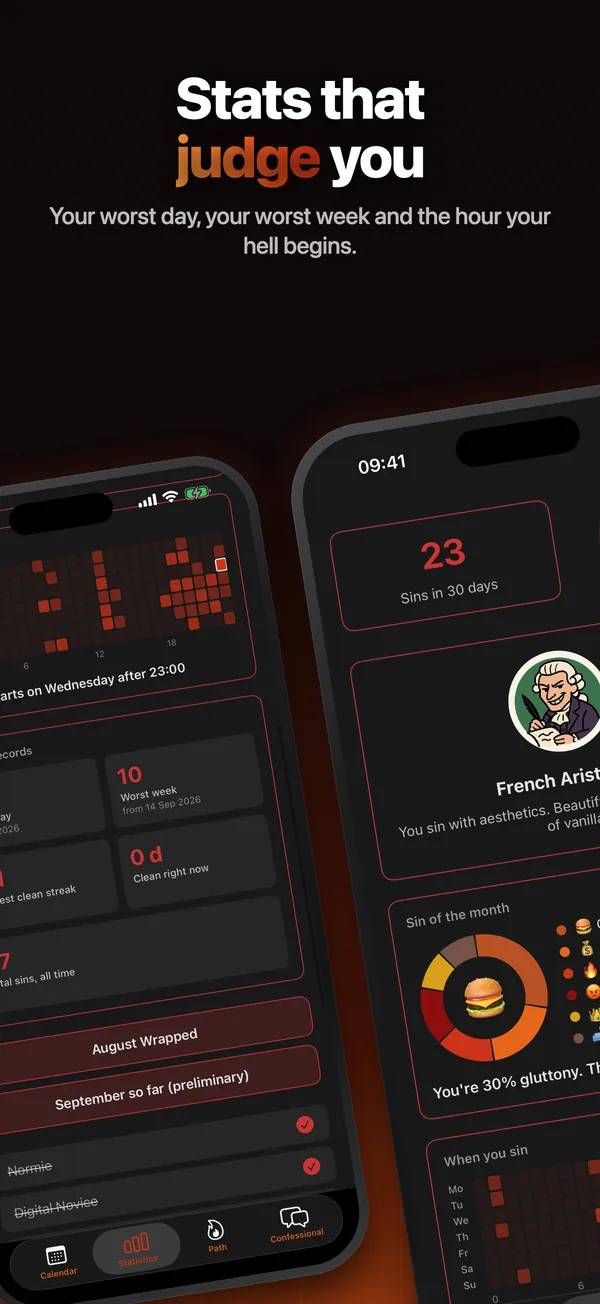
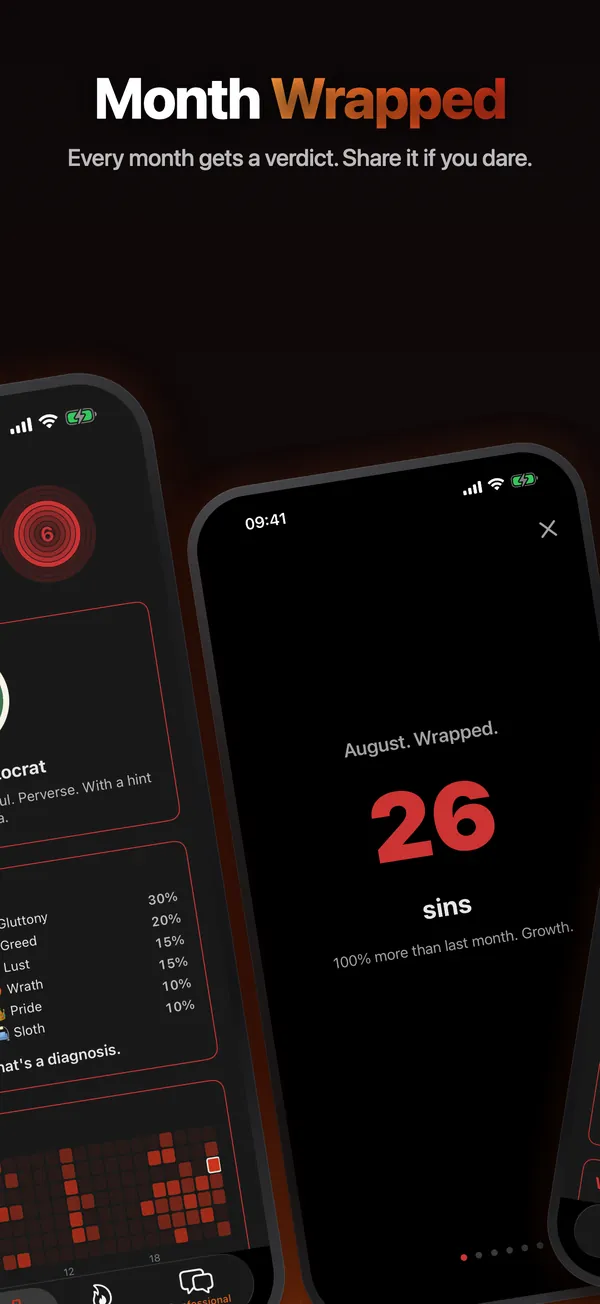
Your worst day and worst week, the hour your personal hell usually begins, a heat map of when you sin, and the sin of the month with a verdict nobody asked for. Every month also gets its own Wrapped recap.
Vows and 24 achievements
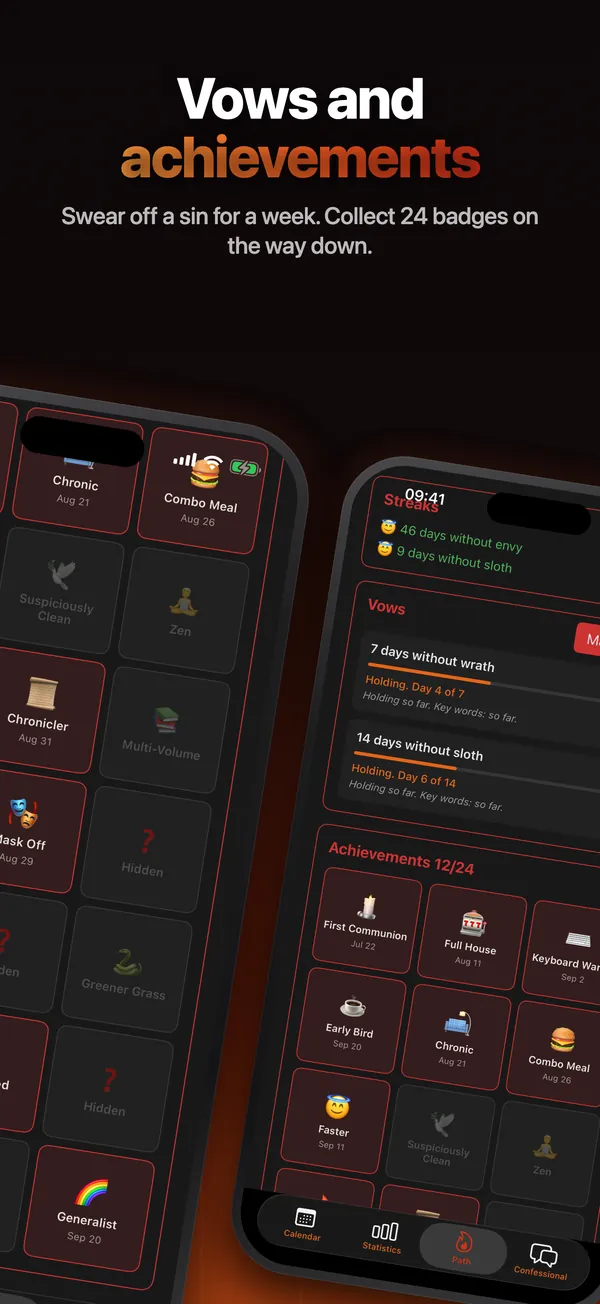
Swear off one sin for seven or fourteen days and watch the streak hold. Twenty-four badges wait on the way down.
Anonymous confessional and duels
Post a sin anonymously, read what others admit and tap "me too". No names or profiles; posts pass a filter first and can be reported. Share a six-character code to duel a friend on who is further down this week.
Apple Watch, widgets, privacy
Log a sin from your wrist, see your level on home and lock screen widgets, plus a Live Activity on record-breaking days. No sign-up, no ads, no tracking: entries stay on the device.
Price
Sin Tracker is free. There are no in-app purchases, no subscription and no ads. Every feature, including the Apple Watch app, widgets, statistics and the confessional, is available to everyone.
Download on theApp StoreFrequently asked questions
What are the seven deadly sins?
Pride, greed, lust, envy, gluttony, wrath and sloth. The list was set by Pope Gregory the Great in AD 590, building on earlier monastic writing. Sin Tracker uses exactly these seven as its categories.
Is Sin Tracker a religious app?
No. It is satire about self-improvement apps, not a spiritual or religious tool. The sins, circles and indulgences are a playful framework for noticing your own habits, and the jokes are aimed at the user, not at any faith.
Is Sin Tracker free?
Yes. The app is free, with no in-app purchases, subscription or ads.
Do I need an account?
No. There is no sign-up, email or login. The app creates an anonymous device record so that duels and the confessional work, and nothing is tied to your Apple ID.
Where is my data stored?
Your sin entries stay on your iPhone. Only a summary leaves the device so duels can work: how many sins in the last 7 and 30 days, your level and your circle. A confession is sent only when you publish it yourself.
Does it work on Apple Watch?
Yes. The watch app shows your circle, current level and 30-day count, and lets you log a sin straight from your wrist. There are watch face complications too.
How is the anonymous confessional moderated?
Every post passes a filter for profanity, slurs, threats and links before it reaches the feed. Any entry can be hidden or reported, and you can block an author. Reports are reviewed by the developer, and the app is rated 18+.
Can I use it as a real bad habits tracker?
You can: logging is fast, and the statistics show when and which habits show up most. Just keep in mind it is a humorous app, not a diagnosis or therapy.
Guides and articles
The seven deadly sins: the full list and what each one means
The seven deadly sins are pride, greed, lust, envy, gluttony, wrath and sloth. The list comes from early Christian monks and was fixed by Pope Gregory the Great in AD 590; it does not appear in the Bible itself.
Read →How to track bad habits without giving up after a week
Pick one or two specific habits, make logging take seconds, count every slip rather than only streaks, and review the pattern once a week. Research shows that simply monitoring a behavior, especially in writing, makes change more likely.
Read →The nine circles of hell in Dante's Inferno: who is in each one and why
In Dante's Inferno the nine circles of hell are, from top to bottom: limbo, lust, gluttony, greed, wrath, heresy, violence, fraud and treachery. The deeper the circle, the graver the sin in Dante's scheme, and the bottom is a frozen lake, not a furnace.
Read →The seven heavenly virtues and the deadly sin each one opposes
The seven virtues that oppose the seven deadly sins are chastity (against lust), temperance (gluttony), charity (greed), diligence (sloth), kindness (envy), patience (wrath) and humility (pride). An older list with the same name is different: prudence, justice, fortitude, temperance, faith, hope and charity.
Read →The what-the-hell effect: why one slip turns into a binge, and how to stop it
The what-the-hell effect is the tendency to give up on a goal completely after one small slip: "I already broke my diet, so I might as well eat everything." Psychologists Janet Polivy and Peter Herman documented it in dieters, and the fix is less guilt and looser rules, not more willpower.
Read →Sloth vs. laziness: what the sin of acedia originally meant
Sloth, as one of the seven deadly sins, did not originally mean laziness. The older word is acedia, Greek for "lack of care": a restless, heavy indifference in which a person stops caring about what matters most to them. Being idle is only one of its symptoms, and being busy can be another.
Read →More apps

ISL: Looper & Song Sketches
8-track looper, guitar, accordion, pads, notes by ear, MIDI export

Honestly
510 questions, party mode with dares and AI questions

Orbita
Measure a ring on screen: US, UK, EU, JP sizes, offline

iKlyukalo
Joke clicker: Dynamic Island, achievements, Game Center

Trichrome
Nine colour puzzles: hidden numbers, hue order, gap ring

ISL Solfege
Solfege course: 72 lessons, intervals, dictation, rhythm, tab