PoolDose – Pool Calculator · iOS 17+
Pool chemical calculator: what to add and how much, today
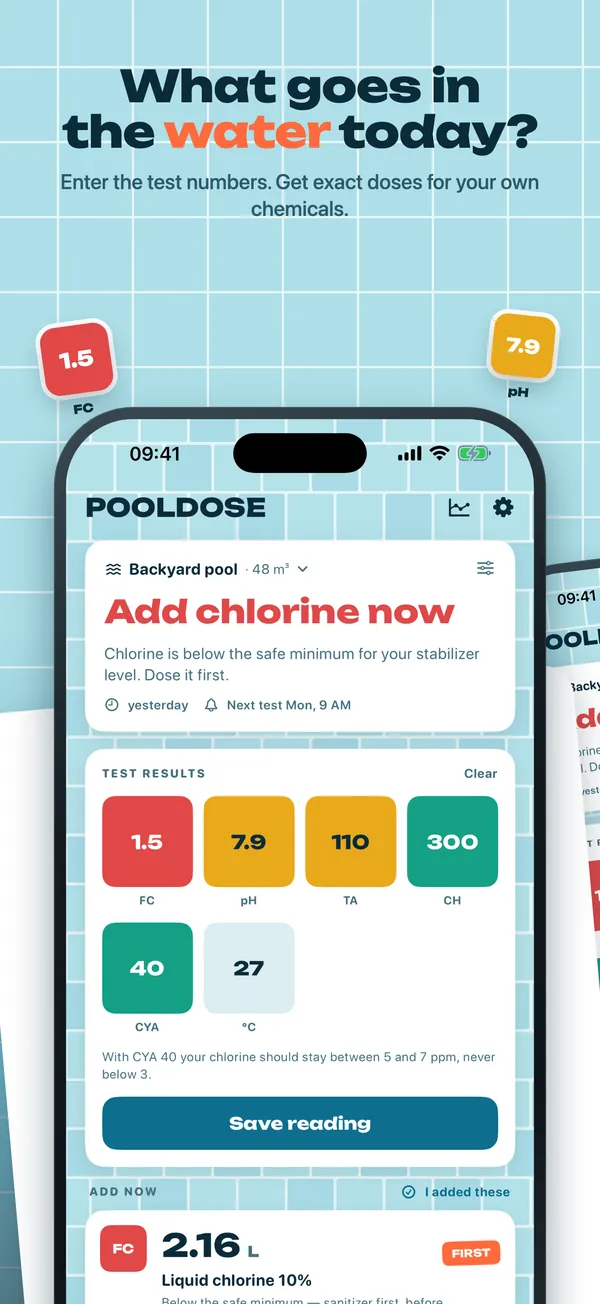
PoolDose turns the numbers from your test kit into a dose list for the chemicals you already own. For pool and hot tub owners who want exact amounts instead of "one cup per 5,000 gallons".
Why pool chemistry feels like guesswork
- The bottle says "one cup per 5,000 gallons", but your pool isn't 5,000 gallons, your chlorine isn't the strength on that label anymore, and you started at 2 ppm, not zero.
- You keep chlorine at the 1–3 ppm everyone quotes and the pool still turns green. Nobody mentioned that stabilizer changes how much chlorine you actually need.
- pH creeps up every week, you add acid, alkalinity drops too, and the next week you're back where you started.
- Hot tub advice is mostly pool advice scaled down, even though hot water, small volume and heavy use change the numbers.
How PoolDose works
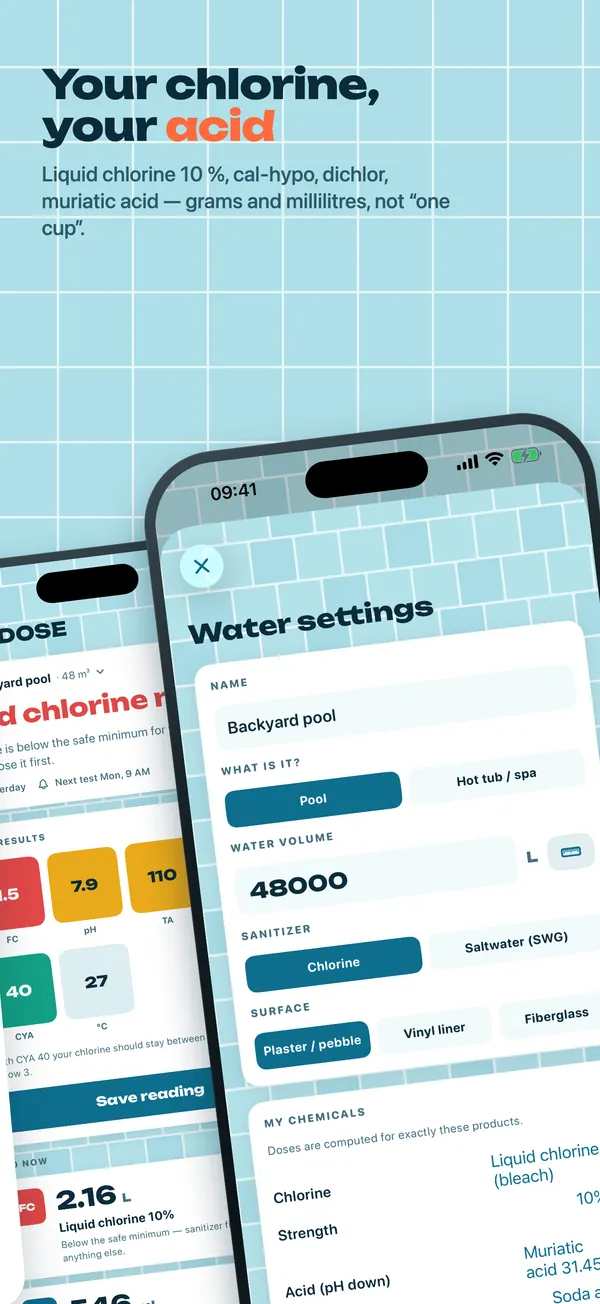
Doses for the chemicals on your shelf
Choose what you own: liquid chlorine at 6, 8.25, 10 or 12.5 %, cal-hypo, dichlor, trichlor, muriatic acid 31.45 or 14.5 %, dry acid, soda ash, borax, baking soda, calcium chloride, stabilizer, salt. Doses come in grams and millilitres or ounces and fluid ounces.
Chlorine target from the FC/CYA chart
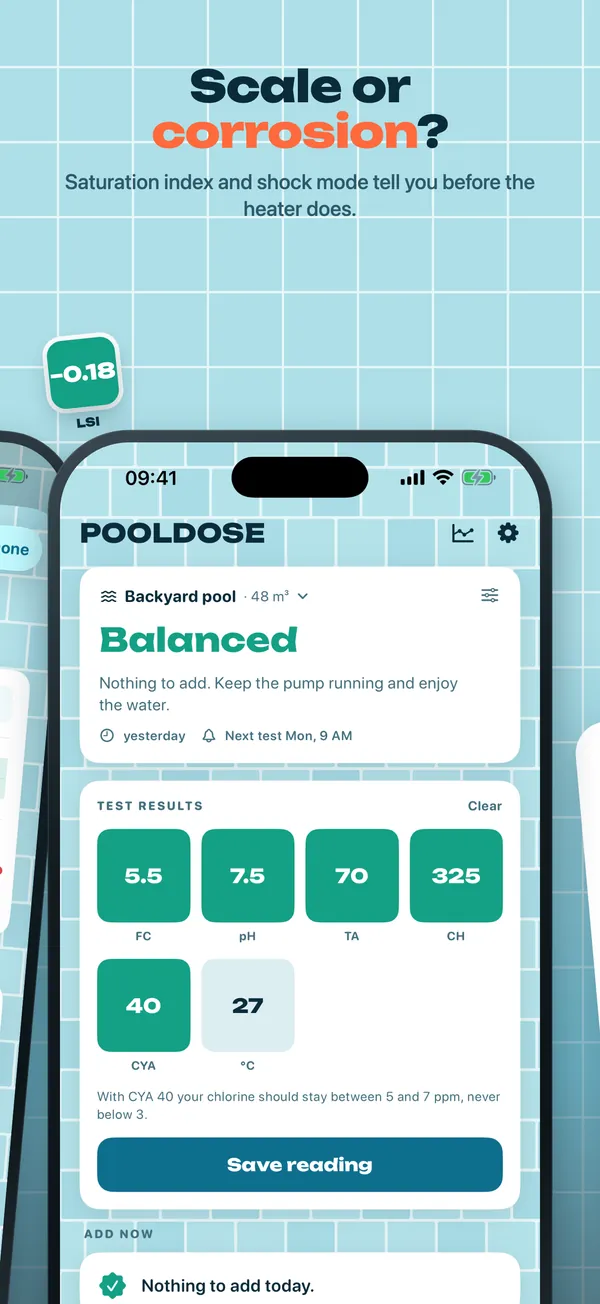
Enter your stabilizer level and PoolDose shows the safe minimum, the target range and the shock level for it, following the Trouble Free Pool chart. Salt water pools get their own lower minimum.
pH and alkalinity from real chemistry
Acid, soda ash, borax and baking soda doses are computed with a carbonate equilibrium model that accounts for TA and CYA, and each dose shows how it will shift the other value.
Order of operations
Urgent items come first, with notes on what to do: wait 30 minutes between products, aerate after lowering TA, pre-dissolve calcium chloride, put stabilizer in the skimmer and wait a week.
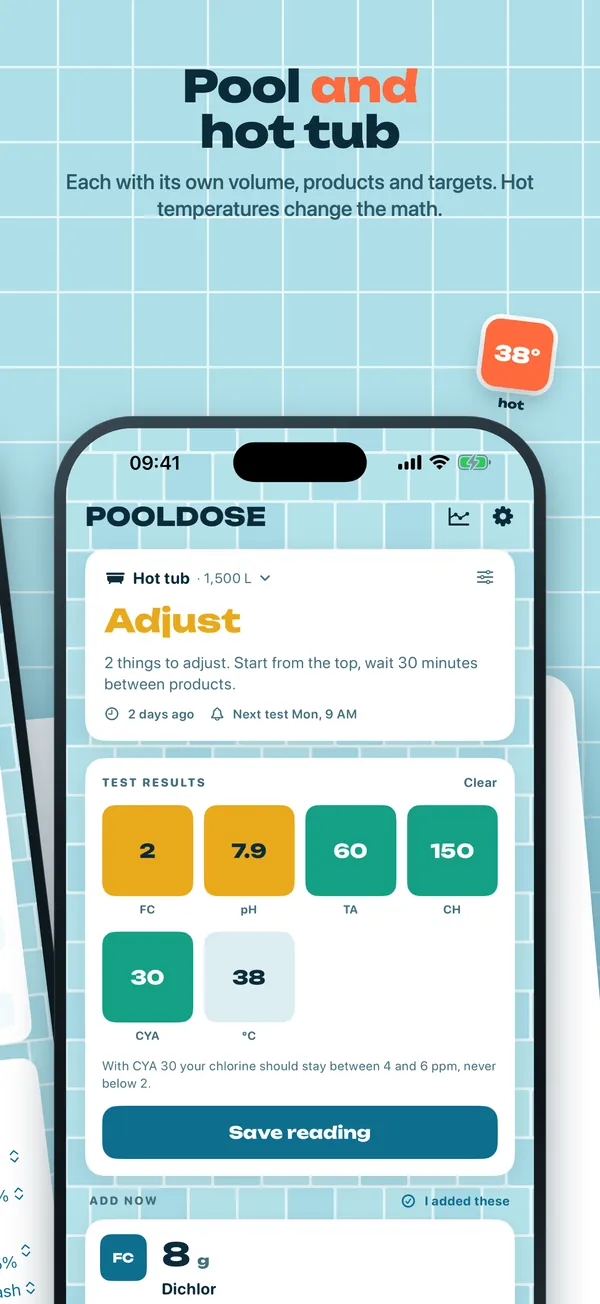
Pool and hot tub modes
Spa mode uses spa targets. A volume calculator handles rectangular, round, oval and freeform pools, averaging the shallow and deep end.
Scale or corrosion warning (Pro)
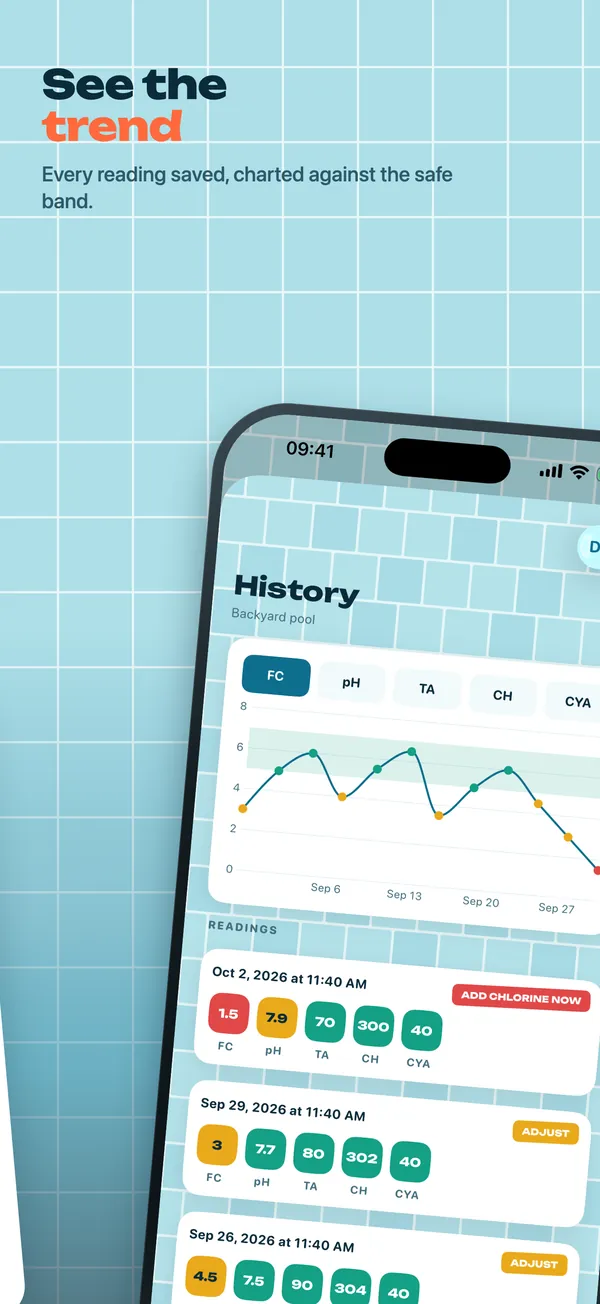
The Langelier saturation index uses pH, TA, calcium, temperature and CYA to tell you whether water will scale the heater or etch plaster. Pro also adds a SLAM dose, reading history with charts and widgets.
Free and Pro
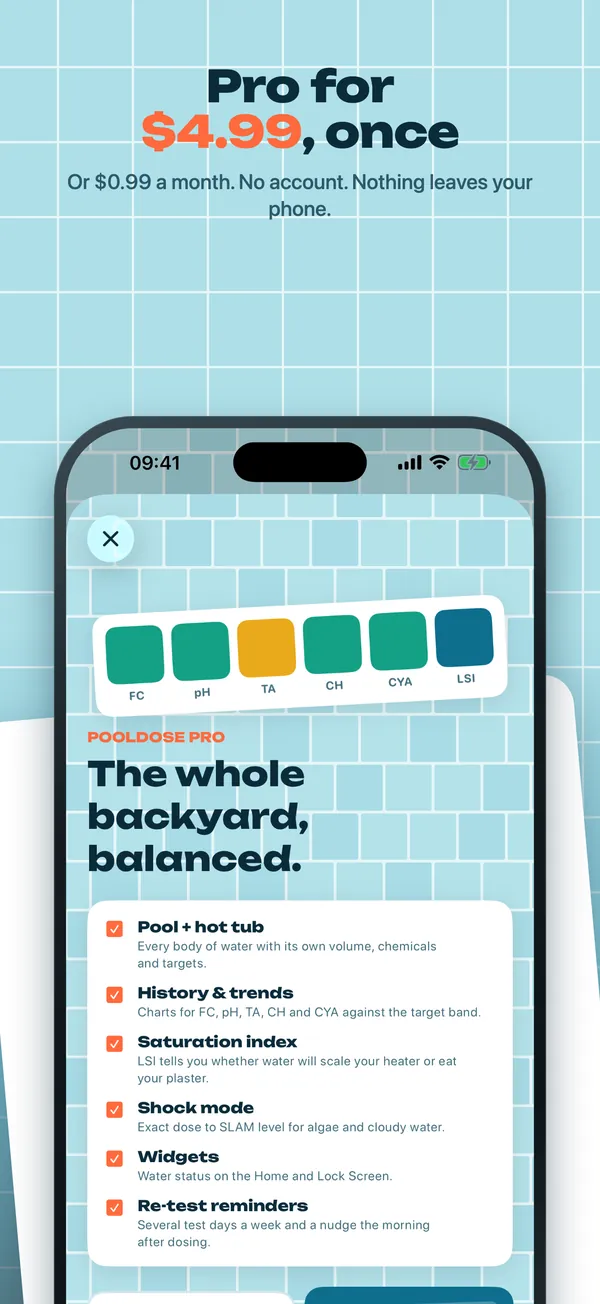
Free: one pool or hot tub, the volume calculator, the full dose plan for FC, pH, TA, CH, CYA and salt, a weekly test-day reminder and your last reading. PoolDose Pro is $0.99 per month or $4.99 once: several pools and hot tubs, reading history with charts, the saturation index (LSI), shock (SLAM) mode, Home Screen and Lock Screen widgets, several test days a week and a re-test reminder the morning after dosing. No account, no analytics; data stays on your iPhone.
App StoreComing soon to the App StoreFrequently asked questions
How much liquid chlorine do I add to raise free chlorine by 1 ppm?
Multiply your volume in litres by the ppm increase and divide by 10 times the product strength. For 10,000 US gallons that is about 379 mL (12.8 fl oz) of 10 % liquid chlorine, or about 303 mL (10.2 fl oz) of 12.5 %.
What free chlorine level should my pool have?
The CDC sets floors of at least 1 ppm in pools, 2 ppm with stabilizer and 3 ppm in hot tubs. With stabilizer, home pool owners often follow the Trouble Free Pool FC/CYA chart instead: a minimum around 7.5 % of CYA, so at 40 ppm CYA keep at least 3 ppm, ideally 5–7 ppm.
Why does my pool turn green even though it has chlorine?
The most common reason is high stabilizer. CYA binds most of the free chlorine, so 2–3 ppm FC is not enough at 70–80 ppm CYA. Stabilized tablets and dichlor keep adding CYA, which only leaves the pool with water that is drained or splashed out.
How do I lower alkalinity without wrecking pH?
Lower both with acid to pH 7.0–7.2, then aerate with jets, a waterfall or a fountain until pH rises back to about 7.4–7.6. Aeration raises pH without raising TA. Repeat until alkalinity reaches your target.
Does PoolDose work for hot tubs and salt water pools?
Yes. You can set up a hot tub with spa targets and hot-water defaults, or mark a pool as salt water, which uses a lower chlorine minimum and adds salt to the dose plan. Keeping a pool and a hot tub side by side requires Pro.
Do I need a drop test kit or are strips enough?
PoolDose accepts numbers from either. Strips are rough at higher chlorine and stabilizer levels, so if your doses keep missing, a drop-based kit with FAS-DPD chlorine and a CYA turbidity test gives more reliable input.
Does the app need an account or send my data anywhere?
No. There is no account, no cloud and no analytics; readings and settings stay on your iPhone.
Is the calculator a substitute for the product label?
No. It does the arithmetic, but the safety directions on each product still apply: never mix chemicals, add them to water rather than water to acid, and keep the pump running while dosing.
Guides and articles
How much chlorine to add to your pool: the formula
Millilitres of liquid chlorine = ppm increase × pool litres ÷ (10 × strength in %). For 10,000 US gallons that is about 12.8 fl oz of 10 % liquid chlorine per 1 ppm, and your target should come from your CYA level.
Read →The FC/CYA ratio: how stabilizer sets your chlorine level
Keep free chlorine at least 7.5 % of your CYA, aim for about 11.5 % or a little above, and shock at 40 %. At 40 ppm stabilizer that means a minimum of 3 ppm, a 5–7 ppm target and 16 ppm for SLAM.
Read →How to lower (and raise) pH and alkalinity in a pool
Acid lowers both pH and total alkalinity; to lower alkalinity alone, add acid to pH 7.0–7.2 and then aerate until pH climbs back to 7.4–7.6. To raise them, use baking soda for TA and aeration, borax or soda ash for pH.
Read →More apps

Nightkit
CPAP replacement reminders on the Medicare schedule

Wink
Days left on your contact lenses, with timely reminders

Siphon Aqua
Days since your last water change, and a reminder for the next
iSimpleLoop
Pocket loop station: 8 tracks, guitar, keys, pads, MIDI export

Sin Tracker
Seven sins, one calendar, zero motivational quotes

Честно
420 вопросов для свиданий, пар и компании